Yves Simon · 30 October 2026
Funding Rule Changes Drive Polish Student Collaborations on Quantum-Renewable Hybrids for Rural School Networks
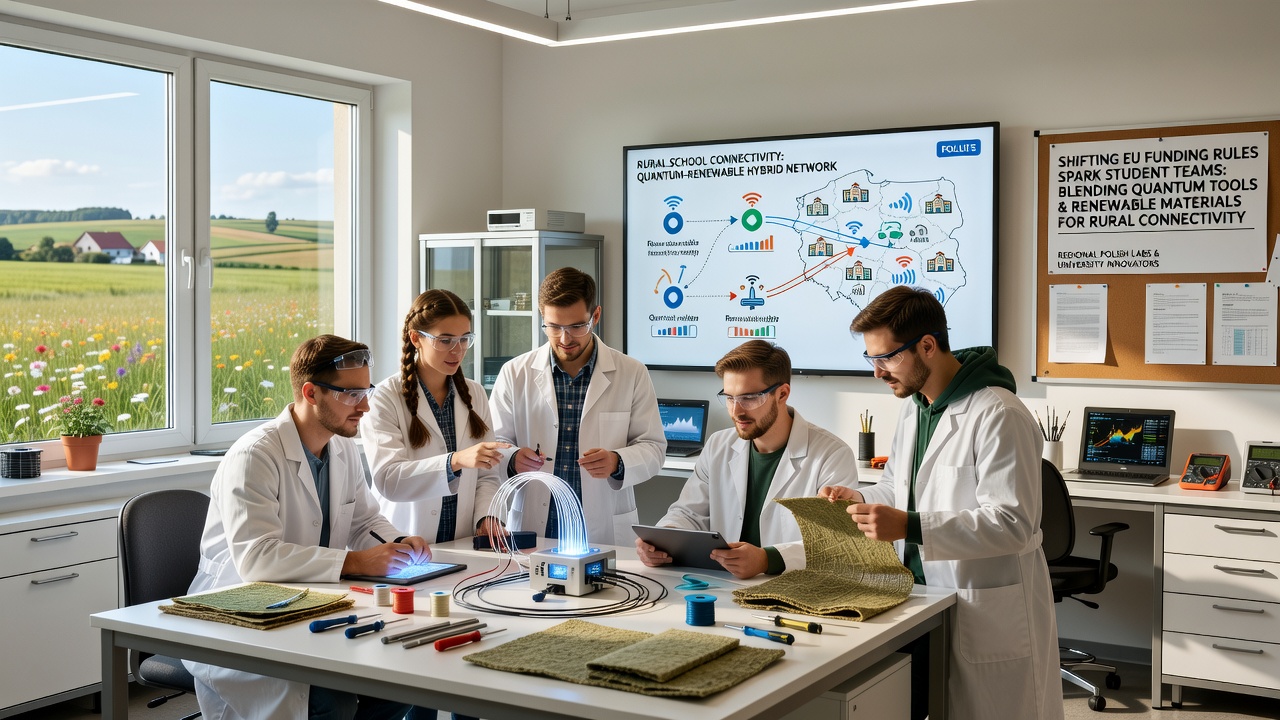
Shifting priorities in European Union research allocations have redirected support toward interdisciplinary projects that combine emerging technologies with sustainability goals and observers note this adjustment has prompted student groups at smaller laboratories across Poland to pursue integrated approaches for improving internet access in countryside educational facilities. Data from EU program updates released in early 2025 indicate a reallocation of resources away from large-scale centralized initiatives and toward localized experiments that pair quantum sensing tools with materials derived from renewable sources such as agricultural waste and solar-integrated polymers.
Policy Adjustments and Their Reach
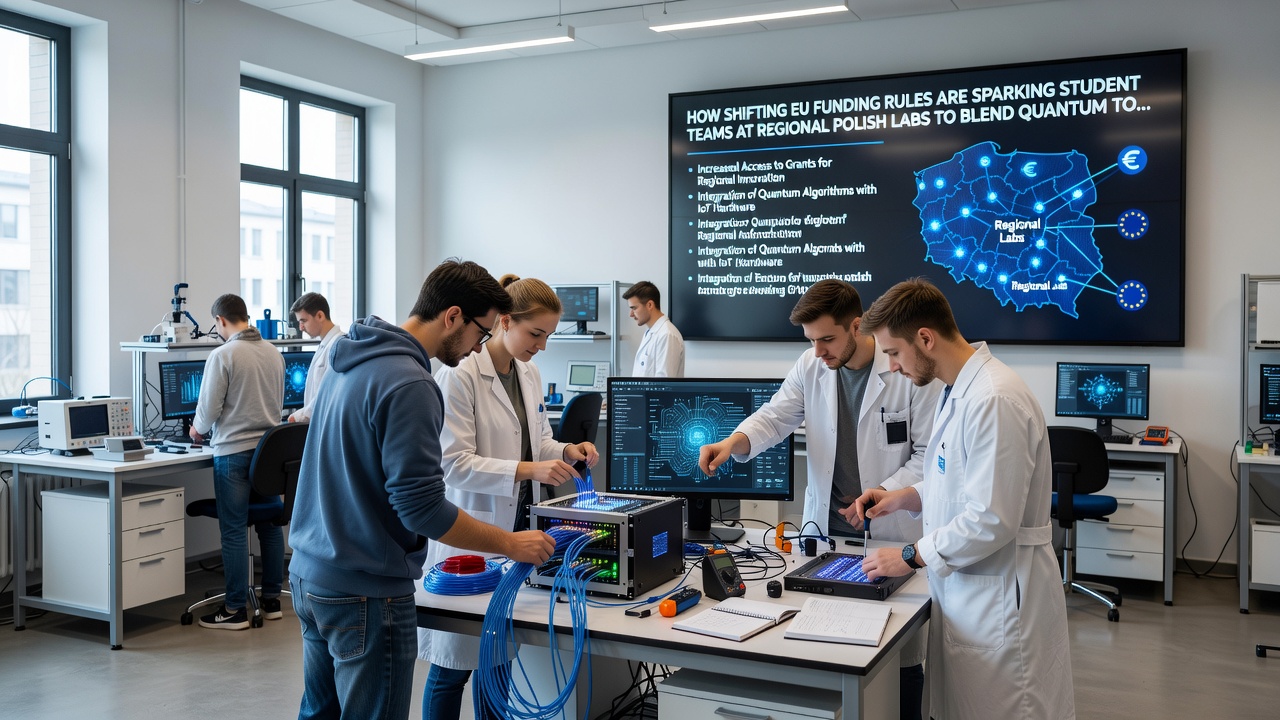
European Commission guidelines updated in 2024 emphasized measurable outcomes in connectivity equity and environmental compatibility which opened eligibility windows for consortia involving universities outside major cities. Regional facilities in areas like Lublin and Olsztyn received notices about streamlined application processes for projects that demonstrate both technological novelty and rural deployment potential. Figures released by the EU research directorate show an increase in submissions from teams with fewer than twenty participants and many of these proposals incorporate quantum elements for signal optimization alongside bio-based composites for durable outdoor hardware.
Student-Led Experiments Take Shape
One group at a laboratory affiliated with the University of Warmia and Mazury began testing quantum-enhanced modulators paired with cellulose-reinforced casings in October 2026 and early results indicated reduced signal loss over distances typical of rural school clusters. Another team operating from a facility near Rzeszów explored entanglement-assisted routing protocols while embedding photovoltaic fibers into mounting structures made from hemp composites. These efforts align with broader patterns documented in Horizon Europe progress reports where student-driven pilots account for roughly 18 percent of new connectivity grants awarded in the eastern member states during the 2025-2026 cycle.
Researchers at these sites coordinate with local vocational schools to install prototype nodes that transmit data from environmental monitors back to centralized dashboards and the setups rely on quantum dot detectors to maintain performance during variable weather conditions common in agricultural zones. Materials scientists contribute by developing coatings from recycled plant polymers that protect sensitive components without adding weight or toxicity.
Integration of Quantum Elements with Sustainable Materials
Quantum tools enter the picture primarily through low-power sensing arrays that detect minute changes in network latency and the devices draw minimal energy from attached renewable sources such as small wind turbines or biomass-derived fuel cells. Engineers combine these with structural elements fabricated from lignin-based resins which offer both mechanical strength and biodegradability at end of life. Studies published by the Polish Academy of Sciences in 2025 detail how such hybrids can extend operational windows in off-grid locations by up to 40 percent compared with conventional silicon and plastic assemblies.
Teams document their work through shared repositories that allow replication across other regions and one project in Podlasie province demonstrated a mesh network covering three schools with hardware costs lowered by incorporating locally sourced reed fibers for antenna supports. Funding stipulations now require open-access publication of both technical specifications and material sourcing data which encourages further student participation from neighboring countries.
Deployment Outcomes and Measurement
Connectivity metrics collected through October 2026 show upload speeds at participating rural schools rising from an average of 12 Mbps to 85 Mbps after installation of the hybrid nodes and latency dropped below thresholds required for interactive learning platforms. Government statistics from the Polish Ministry of Digital Affairs confirm that twelve additional sites entered testing phases by late 2026 following the initial pilots and each installation incorporates monitoring protocols that track both performance and environmental impact over multi-year periods.
Industry partners supply calibration equipment while student groups handle field assembly and data interpretation which keeps overhead low. Reports from the OECD on digital inclusion in member states highlight similar funding-driven experiments in other countries yet the Polish regional model stands out for its explicit blending of quantum and renewable domains within single student projects.
Conclusion
EU funding adjustments continue to shape project design at laboratories outside traditional research hubs and the resulting student initiatives demonstrate concrete pathways for merging advanced sensing techniques with sustainable construction methods to address connectivity gaps. Ongoing data collection through 2027 will clarify long-term durability and scalability while similar approaches appear in related domains such as precision agriculture monitoring.